
Marion County Release Meanings
“Released” can describe a physical exit from the Marion County Jail, but it does not always mean freedom from all custody. A person may return to the community after posting bond, receiving own-recognizance release, completing time served, or beginning probation. Another person may leave the same building in the custody of the Kansas Department of Corrections, another county, a federal authority, or a treatment placement. That second event is a transfer. The Marion County jail record should show the local departure and, when maintained, the disposition or receiving agency. The court case explains the order behind it.
State prison terms use a different vocabulary. Parole, conditional release, and postrelease supervision place a person in the community while KDOC authority continues. “Discharged” is stronger: it marks the end of the KDOC sentence and supervision obligation. A current roster, a VINE event, a court order, and a KASPER status answer different questions. Reading them as if they were one record causes most release errors.
- Time served
- Custody credit satisfies the confinement ordered at that stage.
- Detainer
- Another authority asks the jail to keep or transfer the person after the local matter ends.
- Discharge
- The sentence and related KDOC supervision have ended.
- Expungement
- A court process that restricts access to an eligible record under Kansas law.
Marion County Custody Exit Types
The next useful record depends on the exit type. A court entry may authorize release, yet jail staff still must receive and verify it, check open warrants or holds, complete property and account work, and record the departure. The docket time is therefore not a reliable substitute for the jail’s physical release timestamp.
| Exit type | Meaning | Best next record |
|---|---|---|
| Bond or recognizance | Community release while the case continues | Jail release event and court docket |
| Time or sentence served | Custody ordered at that stage is complete | Release record and journal entry |
| Probation | Court-ordered community supervision | District Court, Court Services, or Community Corrections |
| KDOC transfer | Custodian changes; the person is not free | Jail disposition, then KASPER |
| Federal or ICE transfer | Another authority takes custody | BOP, ICE, federal court, or receiving agency |
Marion County Release Record Fields
Marion County has not published an online field dictionary for jail releases. The fields below are the useful existing items to identify in a focused request, not a promise that every field appears in every file. Ask for the booking and release record tied to one named person and an approximate booking period. Request the booking photograph separately because an image may be stored or treated differently.
| Requested field | What it can establish |
|---|---|
| Name and identifiers | Whether the file belongs to the intended person |
| Booking number and time | The admission tied to the later exit |
| Arresting agency, charge, case | The legal matter connected to custody |
| Bond information | Whether bond may have supported release |
| Release date and time | The recorded physical exit event |
| Release disposition | Bond, time served, transfer, or another coded result |
| Destination or receiving agency | Whether another custodian took control |
The court file can preserve the complaint, bond order, plea, sentence, probation order, revocation, warrant, and later expungement activity. It explains legal authority, not necessarily the moment the jail door opened. Pair the court disposition with the jail timestamp when exact physical release matters.
Request Marion County Release Records
The county provides a record-copy request form and an open-records guide. The form asks for the requester’s contact details, a specific record description, and the number of copies. Staff time, copying charges, the total, and any prepayment are calculated by the custodian, so no fixed jail-release fee should be assumed.
- Name the person and give the closest known booking period.
- Ask for the existing booking and release record, including release date, time, disposition, and destination if maintained and disclosable.
- List the associated booking photograph separately if it is needed and available under law.
- Request electronic copies and a cost estimate before work begins.
- If access is denied, ask for the written legal basis and the portion that can be released.
Marion County Sheriff / Jail
202 S. 4th Street
Marion, KS 66861
620-382-2144
Ask for the current records custodian and counter hours.
Under the Kansas Open Records Act, an agency must act on a request as soon as possible and by the end of the third business day. That is an action deadline, not a guarantee of production in three days. If the record cannot be produced at once, the response should explain the delay and give the earliest production time.
Kansas Law on Marion Releases
K.S.A. 22-4705 treats release from detention or confinement as a reportable criminal-history event. That does not turn the full state repository into an unrestricted online release list. K.S.A. 45-217 excludes jail rosters and court records from the defined category of criminal investigation records, but it does not force Marion County to create a special 24-hour or 72-hour list.
Juvenile, sealed, expunged, medical, victim, and other protected information may be withheld. A missing public result means only that no public result was found.
K.S.A. 21-6614 governs many conviction and diversion expungements. Eligibility, waiting periods, and exclusions vary. An expunged case may disappear from public Kansas court access, but no source supports a claim that every independent copy vanishes. Marion County also publishes no JailTracker retention period. Court, KASPER, VINE, and jail records each have different retention and access rules.
Marion Release Orders and Court
Marion County sits in the Eighth Judicial District. Its District Court page provides a useful local phone tree: option 2 reaches criminal records, option 4 Court Services, and option 5 Community Corrections. The clerk is at 200 S. Third Street, Suite 201, Marion, and can be reached at 620-382-2104 on weekdays from 8 a.m. to 5 p.m.
Use the Kansas District Court case search for the legal event. A bond order, dismissal, sentence, jail credit, probation order, recalled warrant, or KDOC commitment may explain why custody changed. Older documents and documents filed before the district’s eCourt start may require the clerk. A court order should still be paired with the Sheriff’s release event for an exact exit time.
Marion Self-Reporting Release Dates
Some Marion County Jail stays begin with a scheduled court commitment rather than an arrest. The county’s self-reporting rules direct the person to arrive at an assigned time and park in the gravel lot south of the jail. Arriving more than fifteen minutes late can lead staff to refuse admission and report the problem to the court. Those details make the court file central to understanding a planned stay.
A scheduled report date does not by itself establish the release date. The controlling journal entry may state the term and jail credit, while jail staff calculate and record the actual admission and exit. Holds, warrants, or a later court order can change the outcome. Ask for both the journal entry and the jail release event when a short, court-ordered term must be reconstructed.
The self-reporting rules also refer to stays of more than 72 hours when describing possible commissary privileges. That local phrase is not a release-list window and does not create a three-day release rule. Marion County publishes no local good-time formula in the sources reviewed. Exact computation belongs with the sentence, jail record, and responsible staff.
When the planned term spans a weekend or holiday, do not assume that another county’s release practice applies. The Marion sources give no special weekend-release timetable. Record the sentence language, ask the jail for its calculated exit, and confirm the completed event afterward. That method also catches a new hold or warrant that prevented the expected release.
Mail After a Marion Release
The official jail information page says mail received for a person no longer held at the Marion County Jail is returned to the sender. The jail does not forward it. This is a concrete sign that current-inmate services stop when the person departs, but returned mail does not show when the exit occurred, why it happened, or where the person went.
Anyone trying to reconnect should not use the jail’s mail policy as proof of community release. A transfer produces the same end to local mail service. Confirm the departure through VINE or a jail record, then follow the receiving agency if the release disposition identifies one.
Find Released Marion County Inmates
Start with custody type, not with a broad name search. Marion County, Kansas has no verified recent-release feed. The live roster only tests current display. The sequence below preserves the difference between absence, release, and transfer.
- Open the county’s jail page and follow its roster link. A match suggests current display, subject to lag.
- Check VINELink or call Kansas VINE for a county-jail custody event. A transfer alert is not a community release.
- Request the Sheriff’s booking and release record for exact historical time and disposition.
- Read the Marion County court case for the bond, dismissal, sentence, probation, warrant, or transfer order.
- If KDOC received the person, use KASPER. For a federal or immigration custodian, use that agency’s locator.
A released person normally drops off the current roster. Disappearance proves only that the person is no longer displayed, not that the person entered the community.
Match a full name with date of birth, booking number, KDOC number, court case number, physical description, or another stable identifier. Common names and aliases create false matches. Record which system was checked and when, since roster and status screens can update after the real event.
KDOC Search for Marion Releases
KASPER, the Kansas Adult Supervised Population Electronic Repository, covers adults sentenced to the Secretary of Corrections since 1980. It includes incarceration, post-incarceration supervision, and discharge. It does not cover every Marion County jail stay. Search by name or KDOC number, then compare date of birth, physical description, photograph, conviction county, and case number.
| KASPER field | How to read it |
|---|---|
| Current Status | Incarcerated, parole, conditional release, postrelease, or discharged |
| Status date | Date tied to the displayed status |
| Movements | Custody or supervision changes with dates |
| Anticipated release date | Current projection, not a guarantee |
| Parole office | Office serving a person under KDOC supervision |
| Sentence fields | Parole eligibility, conditional release, and expiration details |
The KDOC field guide shows the scope of KASPER’s public data. “Parole,” “conditional release,” or “postrelease supervision” means the person has left prison but remains under legal authority. “Discharged” marks the endpoint. KASPER updates on working days, so a fresh change may not appear at once.
The official KASPER interface shows the statewide search used for a Marion County state sentence.
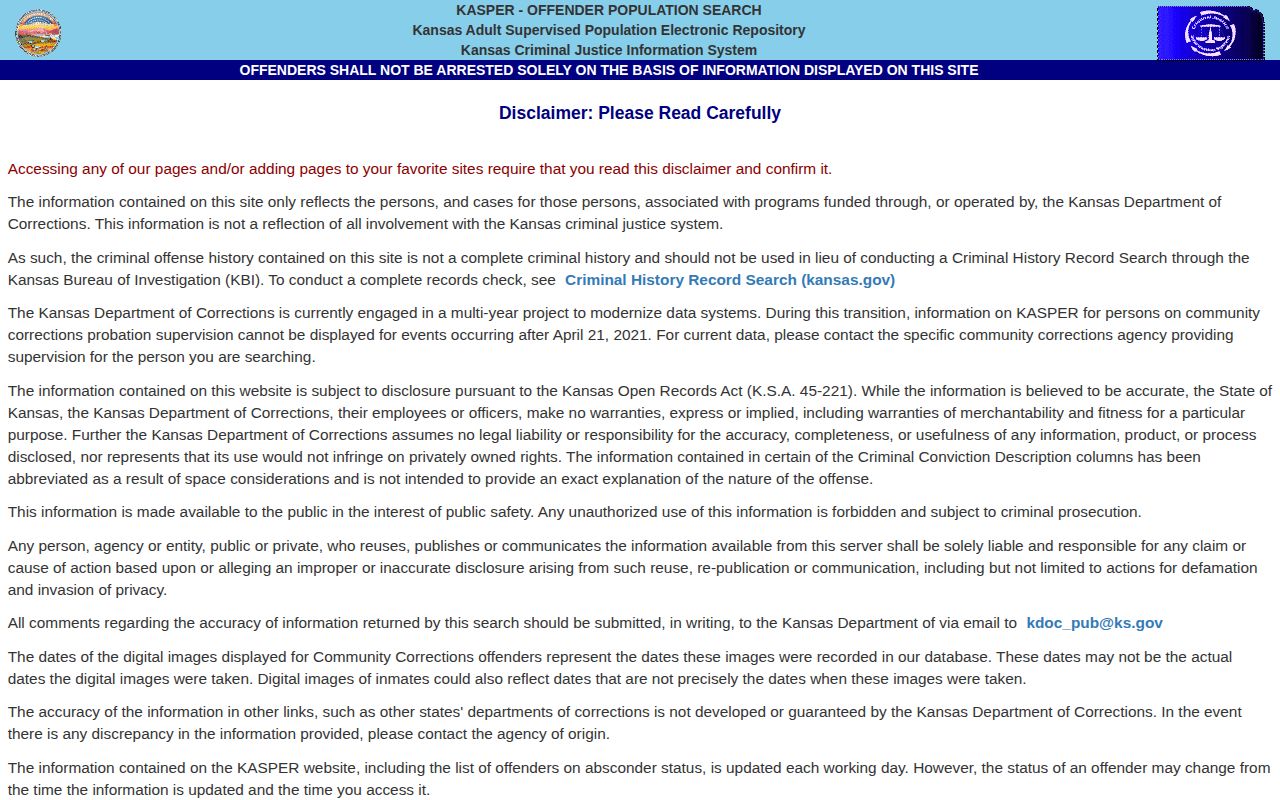
Use the result only after matching several identity and case fields; a no-result search does not disprove a county-jail release.
Marion County Recent Release Limits
No distinct Marion County, Kansas 24-hour or 72-hour release view was identified on the Sheriff navigation, official jail page, or linked JailTracker landing. Do not substitute a similarly named county in Arkansas, Oregon, or Indiana. The state and official domain matter. The Marion County 24-Hour Releases page leads with the available fallback chain rather than a fabricated feed.
The county publishes no roster update promise or after-release retention window. A person might vanish after processing, while a displayed entry might lag a real change. Note the observation time, use VINE for a reported custody event, and obtain a written release record when the exact timestamp or destination matters.
Marion County Post-Release Supervision
Parole is a discretionary release for an eligible indeterminate sentence. Postrelease supervision follows the prison part of many determinate Kansas sentences. Probation is imposed by a court and may run through Court Services or Community Corrections instead of KDOC Parole Services. Marion County post-release supervision therefore splits between state and local offices.
For KDOC supervision, read KASPER’s status and parole-office entry. Marion County is served by the Hutchinson Parole Office. For local probation, the District Court phone tree routes Court Services and Community Corrections. A person can be out of a cell while still subject to supervision, and discharge should never be inferred from release alone.
Marion Release Alerts and Transfers
The Marion County Sheriff promotes Kansas VINE and links to VINELink. It can report county-jail custody changes by phone or email when registration occurs for the correct person. VINE is not a certified release instrument or a permanent historical archive. It covers participating Kansas county jails, not later KDOC prison release. State-prison status belongs in KASPER.
For a federal sentence, use the BOP Inmate Locator. A past release date and “Released” style status can establish departure from BOP custody, but not release from every other authority. For immigration detention, use the ICE detainee locator. A missing ICE result is not proof of release, and an ICE departure may mean removal or transfer rather than community release.
Marion Released or Still Held
Each system has a narrow job. Choose the row that matches the custodian and the question.
| System | Still held | After release |
|---|---|---|
| Marion JailTracker | Current display only, subject to lag | No verified archive or released filter |
| Sheriff release record | Booking record connects the stay | Exact local exit and disposition if maintained |
| VINE | County-jail status and monitoring | Reported release or transfer event |
| KASPER | KDOC incarceration | Parole, postrelease, conditional release, or discharge |
| Court case | Detention, warrant, and case orders | Legal basis for bond, dismissal, sentence, or probation |
| BOP / ICE | Federal or immigration custody | Agency-specific release information and limits |
Marion County Release Facility
The Marion County Jail is the only detention facility identified at a Marion County address in the official sources reviewed. It holds people on local charges, warrants, court orders, and agency holds. A departure may lead to the community, KDOC, another county, a federal authority, treatment, or another placement. The jail disposition is the first record for telling those outcomes apart.
No state prison, federal prison, ICE detention center, or separate regional correctional facility was found at a local address. Municipal arrests may involve short processing, but the county’s public jail information points to this jail. If its record says transfer, continue with the named receiver.