
Marion County Projected and Actual Release Dates
A projected date is a calculation based on the sentence and facts known when the record is viewed. For a person in Kansas Department of Corrections custody, KASPER uses the exact label Anticipated release date. That field is not the same as parole eligibility, conditional release, the start of postrelease supervision, or sentence expiration. It also is not proof that a release happened.
An actual Marion County release is an event. At the county jail, the release record can document the date, time, disposition, and receiving agency if the exit was a transfer. In a KDOC case, a later status such as parole, postrelease supervision, conditional release, or discharged helps show what occurred. “Discharged” is the stronger endpoint because it indicates the KDOC sentence and supervision obligation ended.
A pretrial detainee usually has no sentence-based date to calculate. Release may turn on whether bond is posted, recognizance is ordered, charges change, or another warrant or detainer remains. Even after a judge signs an order, jail staff may need to receive it, check holds, finish account and property work, and record the exit.
How to Find a Marion County Release Date
The correct lookup depends on the sentence location. KASPER covers adults sentenced to the Kansas Secretary of Corrections since 1980. It does not calculate a short Marion County Jail term that never enters state custody, and it does not predict when an unresolved local case will produce release.
- Check the official Marion County Jail roster to learn whether the person is still displayed in local custody. Absence alone does not identify release or transfer.
- For a local sentence, inspect the Marion County District Court case for the journal entry, days ordered, jail credit, and whether counts run at the same time or one after another.
- Ask the Marion County Jail for the existing booking and release record. The jail's calculation and completed release event control the physical exit.
- For a KDOC sentence, search KASPER by name or KDOC number, compare date of birth and case details, and read the anticipated-release field with the sentence and movement data.
- Record the day the portal was checked. If KASPER appears inconsistent, contact KDOC Sentence Computation at 785-296-3317.
- After the projected day, look for a later custody or supervision status instead of assuming the forecast occurred.
The full released-person search sequence, including a written county-record request, is covered on the Marion County released inmates home page. Use identity details such as date of birth, case number, booking number, or KDOC number to avoid matching a different person with the same name.
KASPER Release Fields for Marion County Cases
KASPER is the first public online source when a Marion County case resulted in commitment to KDOC. Its public record may include identity and photograph, convictions, county and case number, sentence-begin date, anticipated release date, parole eligibility, conditional release, sentence expiration, current location, movements, parole office, supervision level, and revocations. Those fields must be read together.
The KASPER search page shows how Kansas presents its public offender lookup.
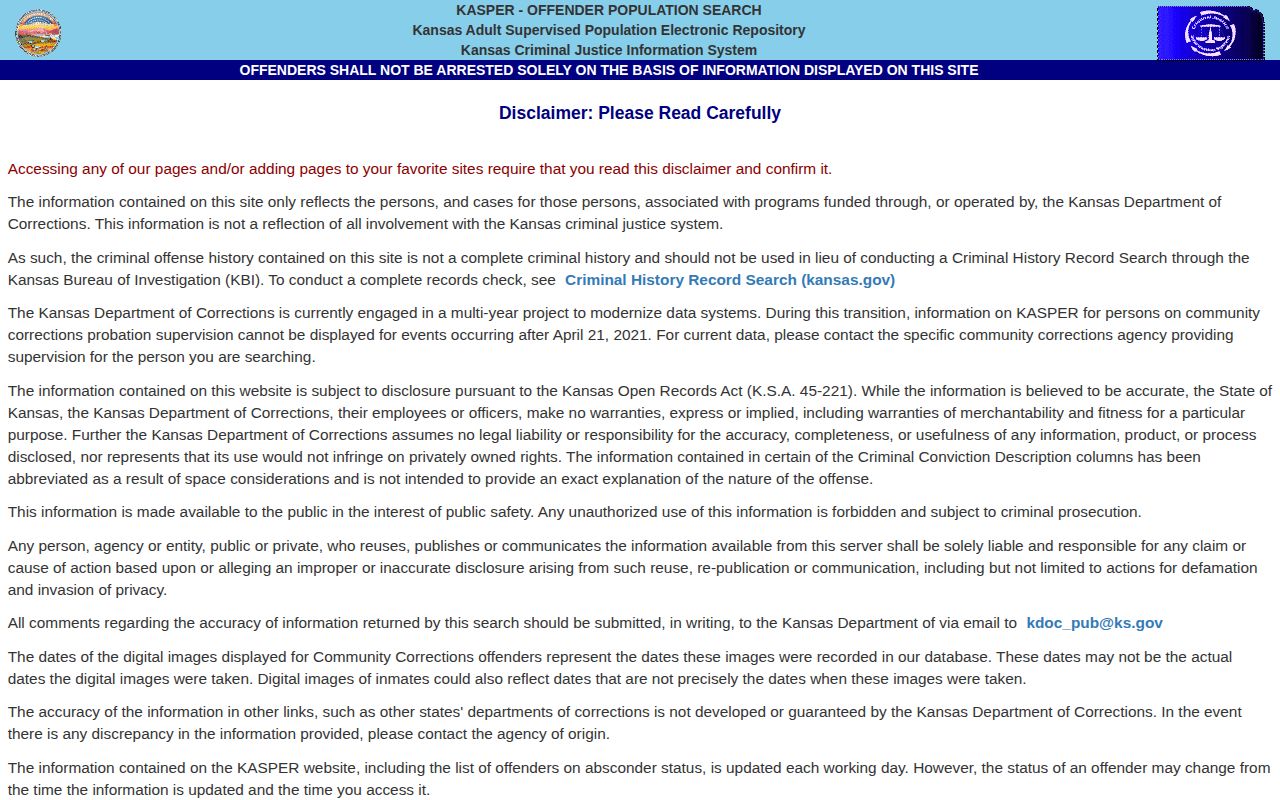
A result can distinguish a person still in prison from one on community supervision or discharged, but the portal does not cover a county-jail-only bond release.
| Field or status | Meaning for release |
|---|---|
| Anticipated release date | A current projection for the prison portion, not a promise of exit. |
| Parole eligibility | The point when an eligible indeterminate case can be considered, not a release decision. |
| Conditional release | A statutory release concept that differs from final sentence discharge. |
| Postrelease or parole | The person has left prison but remains under KDOC authority. |
| Discharged and status date | The state sentence and supervision endpoint shown by KDOC. |
| Movement history | Dates and locations that help distinguish release from transfer within custody. |
Kansas Good Time in a Marion County Release Date
K.S.A. 21-6821 supplies the good-time and program-credit rules for relevant Kansas determinate sentences. For many crimes committed on or after July 1, 1993, subsection (b)(2)(A) caps good time at 15 percent of the prison portion. That is the source of the common shorthand that some prisoners serve about 85 percent before release to postrelease supervision, if all eligible credit is earned and retained.
The shorthand is not a universal rule. The statute permits up to 20 percent for specified nondrug severity levels 7 through 10 committed on or after January 1, 2008, certain drug severity levels 3 through 4 during the statutory 2008 through 2012 period, and drug severity levels 3 through 5 on or after July 1, 2012. Eligibility depends on the offense level and date, not simply on the county of conviction.
Some eligible people serving only specified severity levels may receive up to 120 days of program credit for successful completion of designated programs. Completion of sex-offender treatment does not earn that program credit. Credits are conditional and may be forfeited. For specified sexual or sexually motivated crimes, credit that reduces the prison portion may instead be added to postrelease supervision. A shorter time inside therefore does not always produce an earlier final discharge.
The official Kansas good-time statute sets these limits and exceptions.
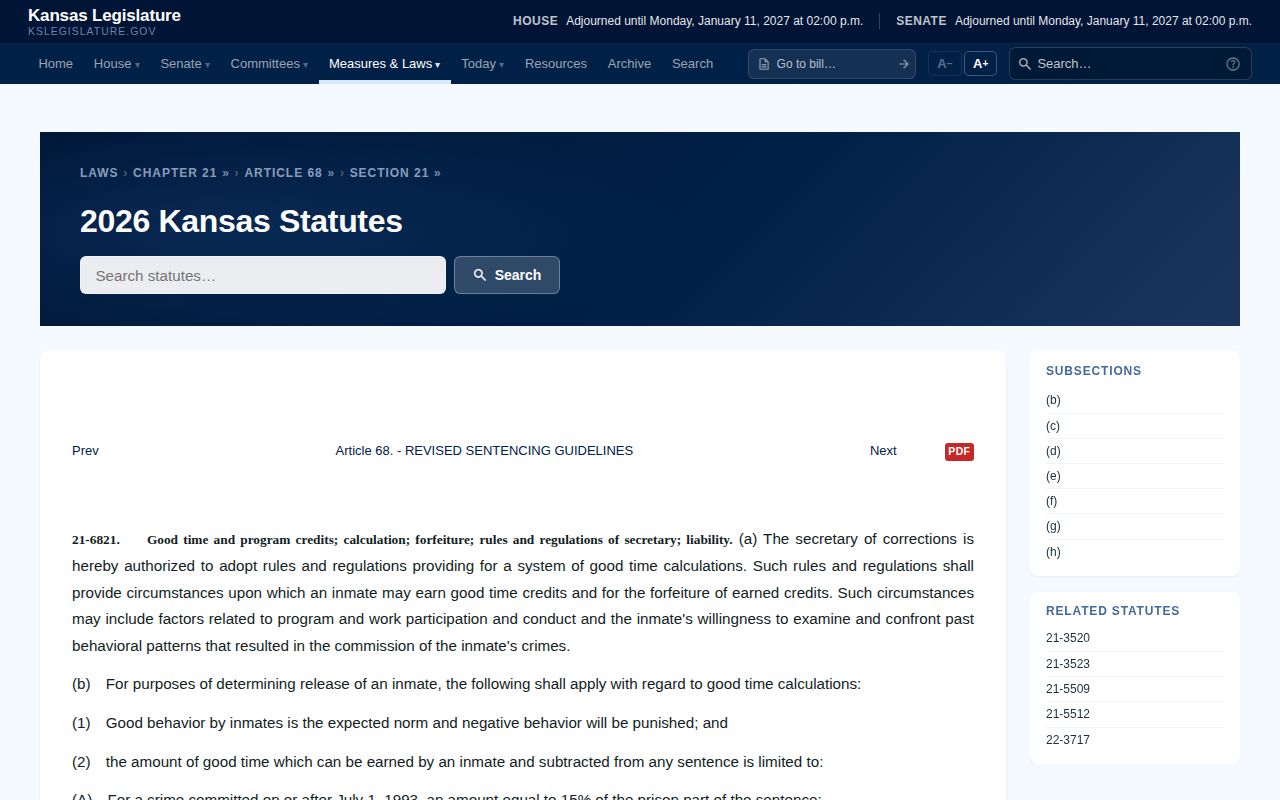
The statute explains why dates can differ across sentences that look similar and why the current KASPER field should be checked instead of calculated from shorthand.
What Changes a Marion County Release Date
A corrections calculation responds to later facts. Some changes affect the end of the prison portion. Others change only the destination or legal status at departure. A transfer to a receiving agency is not release into the community even if the person leaves the first facility on the expected day.
| Factor | Possible effect | Best check |
|---|---|---|
| Good-time earning, forfeiture, or restoration | Moves the calculated prison date within statutory limits. | KASPER and KDOC Sentence Computation |
| Program credit | May reduce an eligible prison portion within the statutory cap. | KDOC record and K.S.A. 21-6821 |
| Court correction or new journal entry | Can alter length, jail credit, or how counts run. | Marion County District Court case |
| Warrant, detainer, or hold | Can prevent community release or cause transfer. | Jail disposition and receiving agency |
| Parole decision | Can grant, deny, or postpone release in an eligible case. | PRB record followed by KASPER status |
| Administrative recalculation | May correct dates after sentence or movement review. | KDOC Sentence Computation |
A name on a Prisoner Review Board calendar means a hearing is approaching. It does not prove a favorable decision. Kansas uses “parole” for a favorable suitability outcome, “continue” when more review is needed, and “pass” for denial. Recheck KASPER after the daily update or request the KDOC record.
Older and Newer Kansas Release Calculations
Older indeterminate sentences and modern determinate sentences do not share one formula. Kansas cases for crimes before July 1, 1993 can operate under parole-eligibility and good-time provisions that include K.S.A. 22-3725. The Prisoner Review Board explains that eligibility in certain cases can occur at one-half of the minimum when required good time is earned. Eligibility still is not release.
Post-1993 determinate sentences generally use a prison portion followed by postrelease supervision. The end of the prison portion may be reflected in the anticipated date, while the sentence continues in the community. This is why “gets out of prison” and “finishes the sentence” can be two different dates for a Marion County case.
Do not blend a parole-hearing date, conditional-release date, anticipated-release date, and discharge date. Each marks a different point in Kansas corrections law and procedure.
Marion County Jail Release-Date Computation
A local jail commitment that never becomes a KDOC sentence will not appear in KASPER as a state anticipated release. The court journal entry, the jail's credit calculation, and the completed release record are the relevant sources. Variables may include days ordered, credit the judge awarded for time already held, and whether multiple counts are consecutive or concurrent.
Marion County publishes self-reporting rules for some scheduled jail commitments. A person is told to arrive at an assigned time, park in the gravel lot south of the jail, and understand that arriving more than fifteen minutes late may result in refusal and a report to the court. Those instructions show that some stays begin by planned court commitment rather than arrest. They do not publish the later exit hour.
No official Marion County page reviewed states a local good-time formula or weekend early-release policy. It would be inaccurate to apply the KDOC percentage caps to a county sentence or promise that staff will shift a date falling on a weekend or holiday.
Confirm a Marion County Release Event
For a county-jail case, use the roster only to see whether the person is still displayed. Kansas VINE covers adults in participating county jails and can send a preregistered custody-change alert for release, transfer, or escape. The alert is useful, but it must be read by event type. A transfer notice means another custodian took over.
The Marion County VINE inmate check guide explains how to monitor one named person. For exact proof, request the jail's existing release event, including date, time, disposition, and receiving agency if applicable. The court docket supplies the legal reason, but it may not show the door time.
For a state sentence, compare the anticipated date with movement data and wait for the later KASPER status. If a public detail is missing, KDOC has a records-request portal. A parole, conditional-release, or postrelease status confirms departure from prison with continuing authority. A discharged status and date identify the later KDOC endpoint.
Federal and immigration custody require different tools. A future BOP release date remains projected, and an ICE result is limited to that agency's custody. Neither changes what the Marion County Jail or KDOC record means.