
Marion County Supervision Types
Parole, postrelease supervision, conditional release, and probation are not interchangeable. Parole is a discretionary release granted by the Kansas Prisoner Review Board, or PRB, to an eligible person serving an older indeterminate sentence. An indeterminate sentence states a range rather than one fixed prison term. Conditional release is a statutory community-release point within that older framework. Both can leave a person under legal custody and conditions after the prison gate.
Postrelease supervision follows the prison part of a determinate Kansas guidelines sentence. A determinate sentence has a fixed term calculated under the sentencing rules. The PRB sets supervision conditions, but it does not simply move the statutory release date forward or backward. Probation usually comes from the sentencing court and allows a person to remain in the community under stated terms. Marion County probation may be administered by Court Services or Community Corrections, not by KDOC Parole Services.
| Status | Decision source | Primary verification channel |
|---|---|---|
| Parole | PRB suitability decision for an eligible indeterminate sentence | KASPER, then KDOC Parole Services |
| Conditional release | Statutory point for an older indeterminate sentence | KASPER or a KDOC record |
| Postrelease supervision | Follows the prison term of a determinate sentence | KASPER and the assigned parole office |
| Probation | Order of the sentencing court | Marion County District Court, Court Services, or Community Corrections |
| Discharge | Full satisfaction of the sentence and supervision obligation | KASPER status or the formal KDOC discharge record |
Check Marion County Supervision Status
Begin with the authority that imposed or administers supervision. Do not use the current Marion County Jail roster to decide whether someone is on parole or probation. That roster concerns current county custody. It does not provide a complete history after release. Likewise, Kansas VINE reports participating county-jail custody events, not a state parole record.
- For a Kansas prison sentence, open the official KASPER offender search and accept its terms.
- Search by the available name or KDOC number. Compare the date of birth, physical description, photo, conviction county, and case number before selecting a record.
- Read “Current Status,” its date, movement entries, and any listed parole office together. Parole, conditional release, or postrelease status means prison departure with supervision. “Discharged” is the stronger endpoint.
- If KASPER is unclear, contact the listed KDOC office. KASPER is generally updated each working day, excluding weekends, so a fresh change may not yet appear.
- For court probation, use the Marion County District Court phone routing and the statewide Kansas case search. The court order shows the legal basis, while the supervising office confirms current administration.
KASPER covers adults sentenced to the Kansas Secretary of Corrections since 1980. It does not cover every release from the county jail. It also warns that some Community Corrections probation events after April 21, 2021 cannot be displayed during system modernization. A missing online event should therefore be checked with the local office rather than treated as proof that supervision ended.
Marion Supervision Routes Through Hutchinson
Marion County state parole is administered from Hutchinson rather than from a parole storefront in Marion. The official KDOC Parole Services contact table assigns Marion County to the South Region Hutchinson Parole Office. This is the correct office for a KDOC supervisee whose record points to that assignment.

The table helps resolve a common local mistake: a Marion County conviction or residence does not guarantee a Marion-based state parole office. Confirm the assignment in the person’s KASPER record before relying on a regional contact.
Hutchinson Parole Office
113 W. 1st Street
Hutchinson, KS 67501
620-669-0175
Automated reporting: 866-570-7225
Local probation takes another route. The Marion County District Court can be reached at 620-382-2104. Option 4 routes to Court Services, while option 5 routes to Community Corrections. The listed Court Services office number is 620-382-3765. Ask which unit holds the current supervision record because probation ordered by the court is not automatically a KDOC parole matter.
Marion County Absconder Records
KDOC provides a statewide parole absconder search that can be filtered by Marion County as the last supervision location. “Absconder” means supervision reports that the person’s location is not known or alleges a failure to comply. It is a supervision status. It is not a recent-release list, and it does not establish current jail custody or the person’s present location.
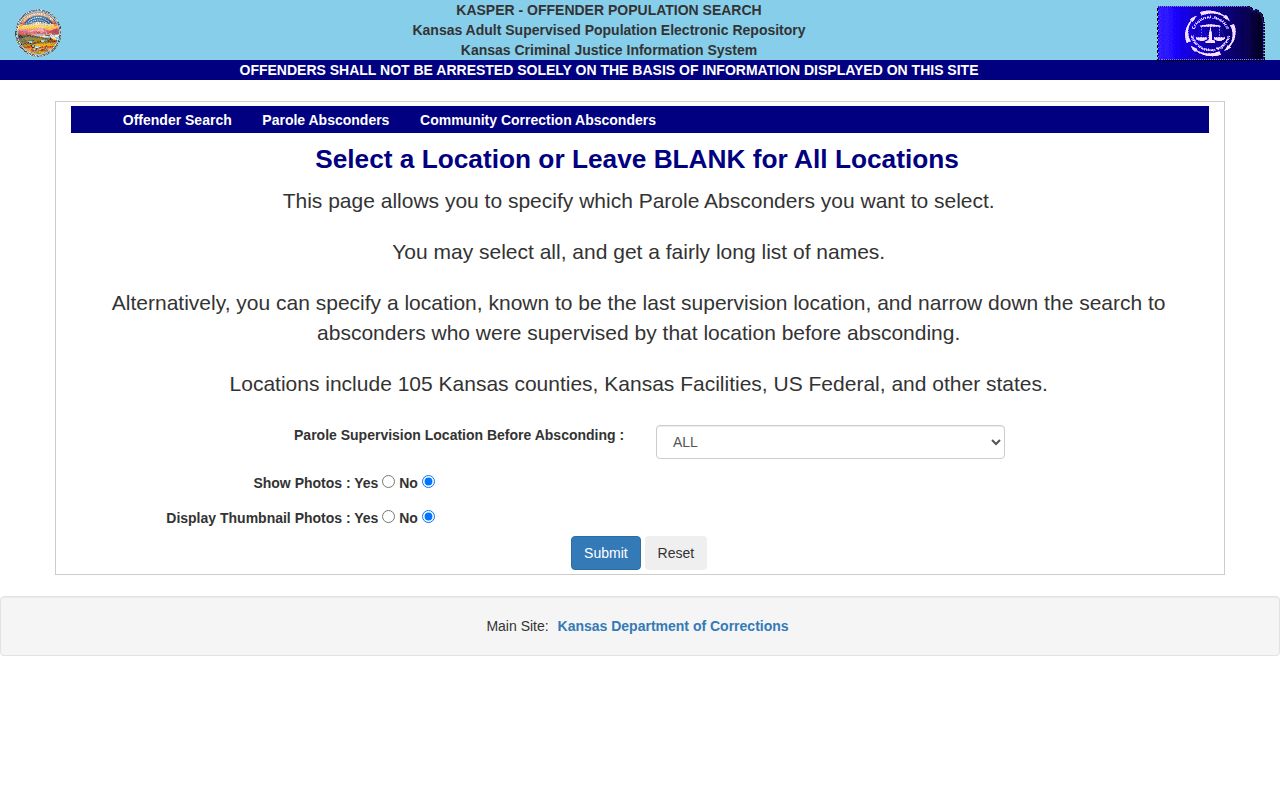
The search may show a photograph and identifying details, but those fields should be compared carefully. The page directs information to law enforcement and KDOC Enforcement, Apprehensions and Investigations at 785-414-7755. A reader should not try to locate, approach, detain, or confront a listed person.
An absconder entry also does not explain the original release event. For that history, use KASPER movements and status, the court case, and a focused KDOC record request. If the question concerns a later county-jail booking, use the Marion County Jail record and VINE. Each channel documents a different event.
Marion Parole Hearings and Outcomes
The PRB public-comment calendar lists monthly sessions held about one month before corresponding parole hearings. A linked offender list may identify commitment name, KDOC number, county of offense, case number, offense information, and facility group. Appearance on that list means a review is approaching. It does not mean the person was released or will return to Marion County.
County of conviction is not the same as residence, supervision county, or release destination. Use the KDOC number to recheck KASPER. Under the official process, “parole” is a favorable suitability decision, “continue” means review awaits more facts, evaluation, or votes, and “pass” means denial. Eligibility itself is never a promise of release.
No official public name-searchable database of individual PRB decisions was identified. After a hearing, recheck KASPER following its normal update cycle or request the relevant PRB or KDOC record through the KDOC records portal. Do not mistake an upcoming-session list for a results search.
Marion Release Conditions and Violations
Conditions are rules attached to community supervision. Their exact terms belong to the governing order or corrections record. A violation can lead to review, added requirements, revocation proceedings, or a return to custody, but a public status should not be used to guess which step occurred. The court docket is the durable source for a local probation revocation filing or order. KASPER and KDOC records are the better route for state parole or postrelease action.
VINE can notify a registered user of a new participating county-jail custody event, transfer, release, or escape. It does not notify the public of every parole condition or prove a supervision violation. If someone on supervision enters Marion County Jail, separate the two facts: the jail event concerns physical custody, while the parole or probation agency determines the supervision response.
Public-record access also has limits. The Kansas Open Records Act gives access to existing public records but does not require an office to answer questions or create a custom report. Some medical, treatment, personnel, and law-enforcement material may be closed or redacted. A narrow request for a status, order, or existing discharge instrument is more useful than a broad demand for an entire supervision file.
When Marion Supervision Ends
Community supervision ends through a documented legal event, not merely through silence in a search. The PRB process describes a maximum-sentence discharge certificate as proof of full satisfaction for the applicable KDOC sentence. An indeterminate supervisee generally must complete at least one year before an early-discharge request may be considered. A parole officer, the PRB, or the supervised person may initiate consideration. Separate statutory rules apply to some determinate postrelease terms.
KASPER may display “Discharged” with a status date. That is distinct from parole, conditional release, or postrelease supervision, which show that prison custody ended but legal supervision continues. When formal proof is needed, ask KDOC for the existing discharge instrument rather than relying on a screen capture alone. For court probation, consult the Marion County case for the termination or satisfaction order and confirm with Court Services or Community Corrections.
Discharge can also matter to an eventual expungement petition under Kansas law, but eligibility varies by offense, sentence, waiting period, and statutory exclusions. It is not automatic. The complete Marion County release-record guide explains how a jail exit, court disposition, supervision status, and final discharge fit together.
A person who has finished a Marion County jail stay may have no KDOC supervision at all. Bond conditions remain part of the pending court case, and ordinary probation is checked through the local court offices. By contrast, a KASPER parole or postrelease entry reflects state corrections authority. Keep the final record tied to the correct system: a court termination order for local probation, a KDOC discharge status or certificate for state supervision, and a jail release event only for the physical county-jail exit.